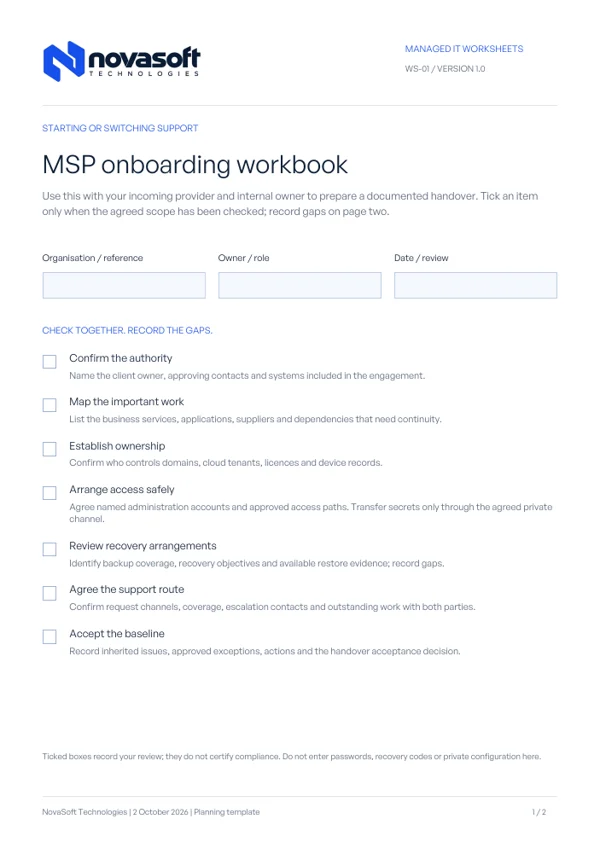
MSP onboarding workbook
List your systems, who owns them and what’s unresolved before you switch IT provider.
Fillable PDF · Checklist + decision record
TRUST & POLICIES / MANAGED IT
Practical workbooks for everyday IT decisions, alongside our public MSP policy framework. Prepare a handover, review access, check recovery or plan the next service review.
4 fillable workbooks · 18 policy PDFs · Complete handbook
Workbooks prepared · Policy framework: draft for adoption
 Complete handbook · 56 pages · 7.3 MB
THE MSP WORKBOOKS
Choose the situation you’re working through, then use a worksheet to prepare the discussion and record the next steps.
List your systems, who owns them and what’s unresolved before you switch IT provider.
Fillable PDF · Checklist + decision record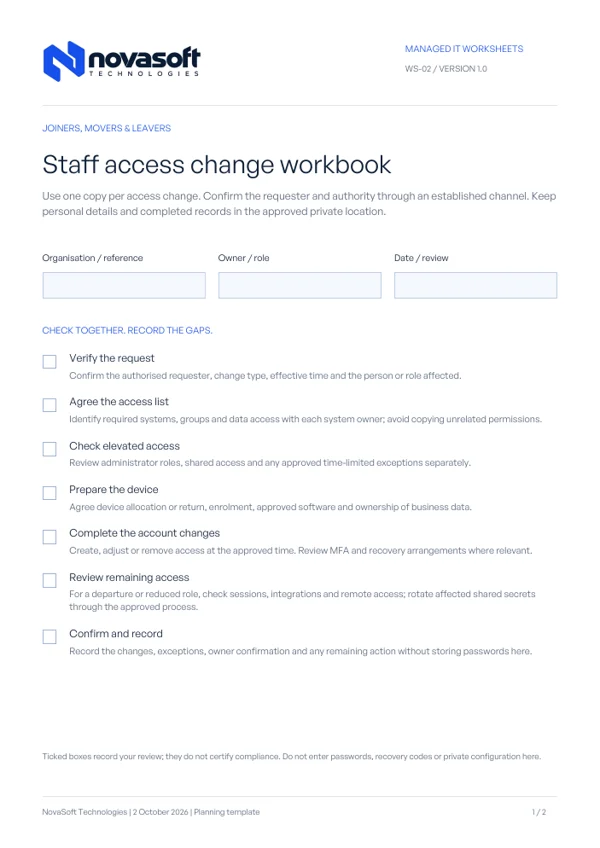
Get access right when someone joins, changes role or leaves.
Fillable PDF · Checklist + decision record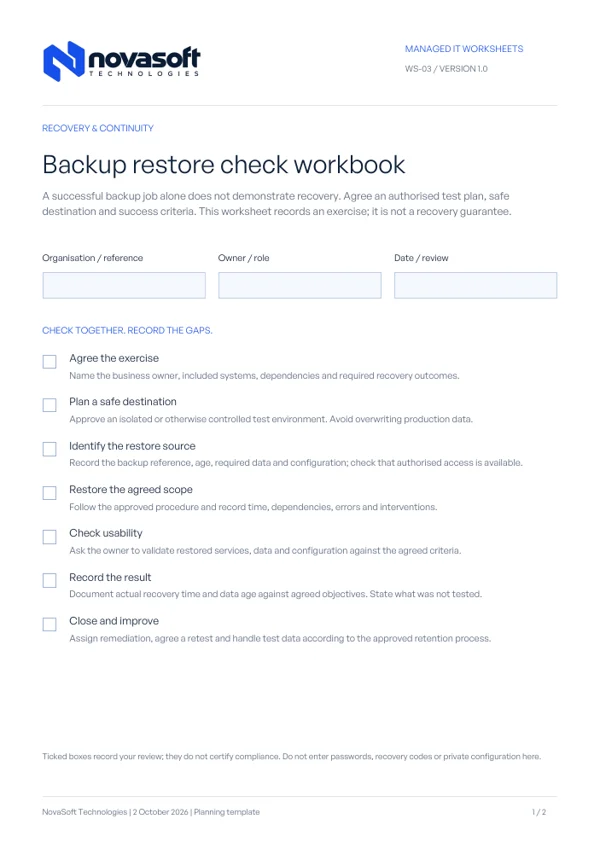
Plan a controlled restore exercise and record what actually worked.
Fillable PDF · Checklist + decision record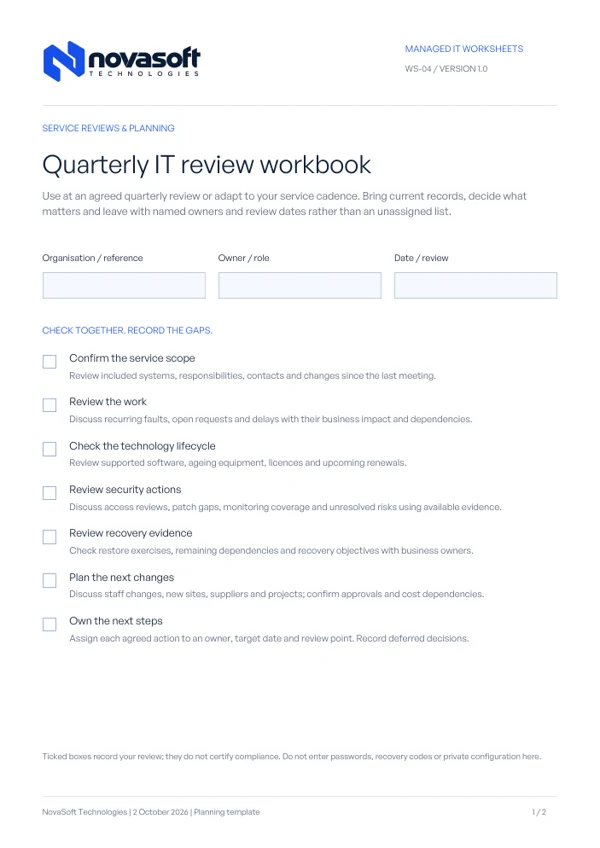
Bring recurring issues, technology risks and upcoming changes into one discussion.
Fillable PDF · Checklist + decision recordComplete in a PDF reader or print for a discussion. Fields work locally in your reader; keep completed records in your approved private system. These planning templates are separate from the draft policy framework.
THE POLICY LIBRARY
18 standalone, three-page PDFs. Each includes scope, roles, control requirements, a workflow, evidence records, client decisions and references.
No policies match your search. Try a broader term or show the full library.
Clear responsibilities, an organised start and a considered handover.
MSP-01 3 pages · 0.5 MB
Establish who can request work, approve decisions and own the systems covered by a managed IT engagement.
Managed services, support requests, service reviews and co-managed arrangements. A signed service schedule identifies included systems, responsibilities, coverage and commercial terms.
MSP-02 3 pages · 0.5 MB
Move into managed support with verified ownership, a documented baseline and explicit acceptance of the starting environment.
New MSP clients, incoming-provider transitions and additions to an existing managed environment. Access and tooling require client authority before installation or connection.
MSP-03 3 pages · 0.5 MB
Provide a controlled exit that transfers authorised material, removes provider access and preserves continuity responsibilities.
Termination, partial service transfer and transition to another provider. Contract terms determine notice, deliverables, fees and retention; this framework adds no new termination charge.
Protect accounts, devices and networks, with a practical response plan.
MSP-04 3 pages · 0.5 MB
Give people the access they need, verify sensitive changes and remove obsolete access across the full account lifecycle.
Client and provider identities, administrative roles, service accounts, joiners, movers, leavers and emergency access within agreed managed scope.
MSP-05 3 pages · 0.5 MB
Set a documented baseline for managed devices and make the boundary between business data and personal use understandable.
Supported desktops, laptops, phones and tablets, including personally owned devices expressly approved for business access. Client scope defines device types and management capabilities.
MSP-06 3 pages · 0.5 MB
Keep management paths controlled and separate client networks, administration and guest use according to business need.
Managed routers, switching, Wi-Fi, firewalls, remote support, VPNs and network administration. Physical works and unmanaged connections require separate scope where applicable.
MSP-07 3 pages · 0.5 MB
Turn identified exposure into prioritised work, documented ownership and reviewable control decisions.
Risk assessments and security improvement plans for managed client environments. Regulatory requirements, threat context and any desired maturity target are established for the engagement.
MSP-08 3 pages · 0.5 MB
Coordinate containment, evidence, recovery and communication when an incident may affect client systems or information.
Suspected compromise, ransomware, unauthorised access, accidental disclosure and service-impacting security incidents. The response schedule defines contacts, authority and specialist support.
Define how information and assistance may be used, shared and reviewed.
MSP-09 3 pages · 0.5 MB
Approve AI around a defined task, control the information it receives and keep consequential actions accountable to people.
NovaSoft Orbit, agentic assistance, third-party AI tools and integrations used in a client engagement. A deployment-specific assessment determines approved uses, data flows and action permissions.
MSP-10 3 pages · 0.5 MB
Handle client information for an agreed purpose, limit access and make relevant collection and sharing understandable.
Personal information and confidential business data in support, administration and managed services. Client notices and applicable jurisdictional requirements must be identified for the engagement.
MSP-11 3 pages · 0.5 MB
Keep information for a documented reason and make deletion, legal holds and residual copies traceable.
Support records, client documentation, logs, exports, device storage and backup copies held within the engagement. Requirements vary by record type, legal obligation and supplier capability.
MSP-12 3 pages · 0.5 MB
Give users practical expectations for business technology, safe reporting and approved use of software and information.
Client users of managed devices, accounts, cloud services and approved AI tools. The client employer adopts workplace rules and gives appropriate notices about any monitoring.
Maintain the environment, manage change and prepare for recovery.
MSP-13 3 pages · 0.5 MB
Maintain a useful inventory and plan licences, support status and replacement before they become operational surprises.
Managed hardware, applications, subscriptions, certificates, domains and technology dependencies. Procurement and renewal authority are specified in the engagement.
MSP-14 3 pages · 0.5 MB
Find relevant exposures, prioritise remediation and verify changes against the actual managed inventory.
Supported applications, operating systems, firmware and managed services in scope. A remediation schedule defines severity criteria, target timeframes and emergency authority.
MSP-15 3 pages · 0.5 MB
Make technology changes deliberate, traceable and recoverable, with authority proportional to their impact.
Configuration, software releases, infrastructure modifications and emergency changes to managed systems. Standard change categories and approvers are recorded for each engagement.
MSP-16 3 pages · 0.5 MB
Agree what must be recoverable, protect backup access and test a practical route back to business operation.
Managed backup jobs, restoration and technology recovery. Client business continuity arrangements also cover people, premises, suppliers and manual processes beyond technical recovery.
MSP-17 3 pages · 0.5 MB
Assess third-party services and configure cloud collaboration around clear ownership, access and information flows.
Managed cloud tenants, business email, SaaS, hosting and suppliers with client data or administrative access. Supplier selection and commercial commitments require client authority.
MSP-18 3 pages · 0.5 MB
Collect useful signals for agreed purposes and connect alerts with a defined owner, response route and information boundary.
Security and operational telemetry from managed systems, remote tools and automated assistance. The monitoring schedule specifies sources, collection, retention and human response coverage.
Keep the 56-page handbook with a contents guide and bookmarks for all 18 policies.
Confirm the systems, responsibilities and evidence that apply to your business.
Apply this framework to the systems and activities included in the written engagement. Record applicable laws, required controls, owners, timeframes and approved exceptions in the client service schedule. A public document does not change a signed agreement or any right or obligation imposed by law.
Explore managed ITThese independently written drafts use Australian ASD/ACSC and OAIC guidance as reference points. The client environment, applicable obligations and approved implementation determine the controls required.
Reviewed for preparation on 1 October 2026. Propose corrections or request an accessible format through our contact page. Client-specific service and incident requests use the channels agreed in your engagement.
Privacy, terms & company informationMAKE THE RESPONSIBILITIES CLEAR
Discuss the environment you need managed and the policy requirements that matter to your organisation.